One day someone smarter than me should sit down and lay it out plain about African-American music in the 18th century: What was going on? The music that we folks in the western hemisphere call “traditional” generally seems to date from the 19th century (or later), so it’s hard to guess what the roots of our traditional music sounded like, but I’m here to posit that 18th century roots music was pretty hot.
Take a look at the musical history of the Caribbean and you find a striking number of similarities. The Africans there tended to get down in the same ways – or at least using the same tools – from island to island. Every island had some combination of drums (many of which were improvised; like the alluringly named “boom pipe” of the Anglophone Caribbean), maracas (called
shak-shaks on many Anglophone islands and
chakchaks on the Francophone ones), scrapers, triangles (called
cling-a-chings,
tingtings, etc.), melodic wind instruments like fifes, pennywhistles, and flutes and/or stringed instruments like the fiddle, banjo, guitar, ukulele or cuatro (which is primarily identified with Puerto Rico, but was present in both the Spanish
and the British Antilles) among others. This is not the place for a reading of Caribbean musical history (though
wikipedia totally is, if you’ve got a few hours to kill), but the similarities between the music on these islands that developed during a time when African adults weren’t even allowed to leave their own plantations, much less pop over to Montserrat from Martinique to see what was doing musically, are amazing and totally worth checking out. The impression that you walk away with was that the early music made by Africans in the New World was still very African indeed. Presumably, slavery shoe-horned the myriad musical traditions of West Africa together to make something new but still familiar enough that it could give birth to music in Trinidad and Tobago (calypso), Jamaica (mento), Antigua and Barbuda (benna), the Bahamas (goombay), the Virgin Islands (quelbe) and Barbados (Barbadian calypso) that were sonic kissin' cousins and used many of the same instruments.
In the U.S. the oldest hot music (or hottest old music) must surely be the fife-and-drum corps of the Mississippi Hill Country. Mississippi farmer
Otha Turner, f-n-d’s most visible exponent in the 20th century, made his own fifes by selecting lengths of bamboo and boring them out with a red hot poker. He made the soundholes on his instruments by licking his fingers and arranging them on the flute in a position that
felt right (!), then burning holes on the spit marks – a chicken-or-egg conundrum that demands tradition account for itself in this process. (I mean, how did he know where to put his fingers so that they felt right in the first place? Who was the first guy that decided where your fingers should go?) In a fife and drum corps, Otha and other blowers of the fife carry the melody of a song, while a bass drummer and at least one snare drummer kick up an accented martial rhythm behind him. Alan Lomax, who first recorded this tradition when he came across Hill Country multi-instrumentalist Sid Hemphill in the early 1940s, theorized the music dated from the 18th century. From the liner notes to
Sounds of the South:
"Thomas Jefferson’s body-servant formed a fife and drum 'combo' with his best friend the day the Revolutionary War broke out, probably to play the patriotic tunes of the day….Today this combination dominates the dance music of Anguilla and Nevis in the West Indies."
(You also hear this tradition, or something like it, in the Tuk ensembles of Barbados. They use a tin whistle rather than a fife. Check out Google video for a 1/2 hour documentary on
the Landship. Eye-opening.)
Ethnomusicologists (and dudes like them) couldn’t get enough of bossy, Budwesier drinking, filterless cigarette smoking Otha Turner, who hosted academics and documentary makers until his
death at 95. He appeared on any number of compilations for labels like
Rounder (
Afro-American Folk Music from Tate and Panola Counties) and
Evidence (
Living Country Blues) before debuting a full-length under his own name in 1997 with
Everybody Hollerin’ Goat (
Birdman), a set of recordings made over several years at his annual picnics. You can find him in any number of documentaries as well. (Dig him in this 10 minute film on FolkStreams.net
here).
Ethnomusicology and Otha Turner met head on in the late 1990s with
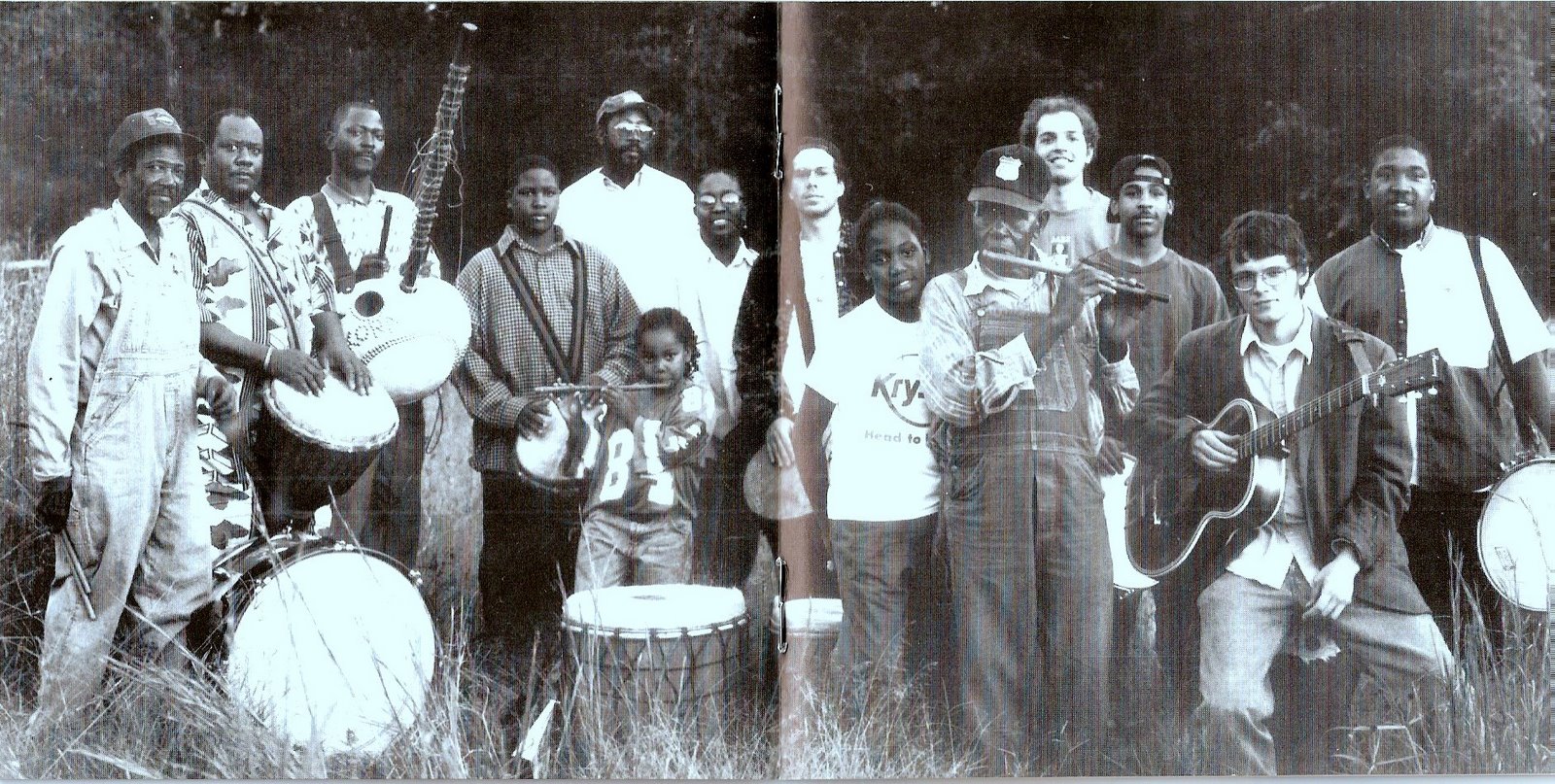
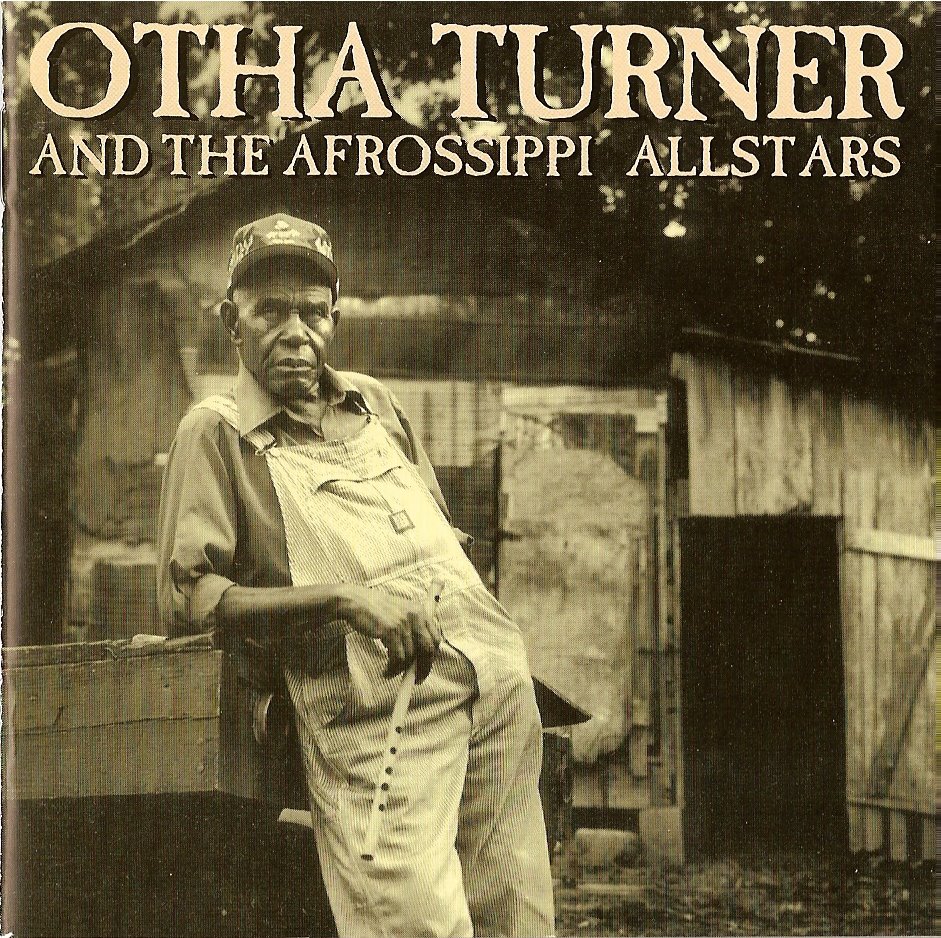
From Senegal to Senatobia, credited to Otha Turner and the Afrossippi Allstars. In an attempt to give an Old World context to this most African of U.S. musics, Minnesotan college student and drummer Matt Rappaport brought a Senegalese kora player and several African percussionists (living in Chicago) to play with Otha and his drum corps.
African-American music is a fusion of African and European elements, and I think that fusion has evolved in a more-or-less organic way since The Day. For my money, cross-cultural experiments like this one generally end in tears. They leave me with the impression that the idea man behind the project wants to devolve the music; sort of “un-fuse” it so that you’re left with its constituent elements, making it easier to categorize. Not so with this album (or the even more ambitious
Fulani Journey album by
Afrissippi – more on it later). I suppose the best one can hope for in an album like this is that everything sounds natural together, that these musicians, whose common culture separated 400 years and 4,662 miles (thank you,
this site) ago don’t screw things up; you know, no one loses the groove or, worse, bumps into the kora and loses an eye. What’s so great about this album is that adding all these African elements to the fife and drum combo seems to invigorate it. It seems like polyrhythmic djembe ensembles should have been in attendance at every Tate County, Miss., country picnic from Day 1.
Having been around since the Revolutionary War (if you’re smoking what Lomax is rolling) the fife and drum sound is pretty well-established. Whether you love it or not (and I love it – just sayin’) you know what you’re in for when you put a fife and drum side on the box: Big head-bobbing beats on the bass drum, breathy harmonics from the cane fife, snappy ass-twitching action from the snare drums. Maybe someone will clap. It’s a tried and true formula, refined over the entire lifespan of the United States, and not much in vogue among the young folks. This record shows what the possibilities for the music actually are. That doesn’t just mean that
From Senegal proves that a cane fife sounds sweet over a djun djun, or even that the fife should have been played over a djun djun all along, which often seems to be the end goal of projects like this. It means that the cultures that produced the fife and the djun djun are still complimentary. Would an Antiguan cling-a-ching player have felt at home in a Dominican bélé ensemble in 1776? This record says yes.
They don’t give the kora player much, but the beats is large.
Here or
here.
 From Senegal to Senatobia
 (2000)
Otha Turner & the Afrossippi Allstars
Birdman, BMR025
Recorded in 1999 at Otha Turner’s farm and Zebra Ranch Studios
Otha Turner – fife, vocals
Morikeba Kouyate – kora
Sharde Evans – fife
Luther Dickinson – bottleneck guitar
Musa Sutton, Manu Walton, Abe Young, R.L. Boyce, Bernice T. Evans, Rodney Evans, Andre Evans, K.K. Freeman, Matthew Rappaport – snare drums, bass drums, djembe, djun djun, sangban, kenkeni, bells, shakers, tambourines